Tuesday, July 20, 2010

The Crab Bulletin, Special Bladensburg Edition


The Cultural Resources Section at the Maryland State Highway Administration (SHA) produces a quarterly newsletter. The summer edition of the Cultural Resources Bulletin (CRaB) is a special extended issue.
It includes in-depth articles on the Bladensburg Archaeology Project, as well as information on other SHA projects. Click on the newsletter link below to read the full edition:

Friday, July 2, 2010

The Volunteer Experience at the Indian Queen: "Why we do what we do..."


This blogpost was written by Olivia Lane, who volunteered her time to help us out in the field this past week. Thanks Olivia!:

Finding the remains of lives long past is a humbling experience, and I would like to thank the State Highway Administration’s Cultural Resources department for allowing me to participate. Sifting through the dirt taught me, contrary to my recent college experiences, that not all PhD’s are afraid of getting dirty. Some actually enjoy their work, and the opportunity to share it with others—mud included. The artifacts uncovered at the site challenge the validity of word-count value of even the best photograph. There is something almost sacred about discovering and holding a tiny piece of a past life in your hands. A shard of pottery with an intricate, hand-painted flower design speaks to the eternal human need for aesthetics and beauty. A child’s marble tells of a simple childhood full of companionship and games. A pig’s jaw bone with teeth intact announces what may have been for dinner.

These artifacts can tell us as much about ourselves as they do about their previous owners. What things will we leave behind, and what will they say about us? Our legacy is everywhere—from plastic water bottles and McDonald’s® wrappers to outdated electronics. But uncovering these items may not hold the same value as the items unearthed at the Indian Queen Tavern, nor will their discovery be as difficult. The trash of the modern world is everywhere, and the half-life of a Dunkin Donuts® Styrofoam coffee cup is much longer than that of a hand-made children’s toy.
Archaeology may be partially about uncovering and preserving the past. It may be partially about learning about the details of the lives that came before us. But to fully understand the field, we must understand that we are finding out about ourselves. As technology and science advance at rapid speed, many things in our lives may change. Our basic needs never do. If we choose to focus on the similarities uncovered in Bladensburg, we may still have a fighting chance.

Wednesday, June 30, 2010

Indian Queen Excavation, Day 15: Last Day of Excavation

Posted by Dr. Julie Schablitsky, Principal Investigator for the Bladensburg Archaeology Project and Chief Archaeologist at the State Highway Administration:

Today we closed up the Indian Queen Tavern site and by mid July, the Anacostia Watershed Society’s parking lot will be restored. Looking back over the last several weeks, I can say that this has been one of the most complex and intriguing archaeological sites SHA and the U of MD has ever excavated. We recorded almost 50 features that included a brick foundations, a brick well, stone foundations, and numerous post holes and molds. The majority of the artifacts ranged in age from the mid 20th century through the mid 18th century; however, we also recovered quartz and quartzite stone flakes and a projectile point from the first residents of Maryland. Based on our excavations at the three archaeological sites in Bladensburg, it is very clear that the Native Americans lived and fished along the Anacostia River for hundreds, and perhaps even thousands, of years.

The history of the Indian Queen Tavern site suggested that we should encounter archaeology from the first tavern on this lot. Jacob Wirt, a German immigrant, and his heirs owned the property from 1763 through 1785 and operated a tavern here. It is unclear how the site was used between the mid 1780s and 1856 (historic research is still pending). By 1856, Francis Gasch, also a German immigrant, owned the property where he operated a cabinet maker/coffin maker shop between 1860 and 1907. The Gasch funeral home is still in operation just up the road (http://www.gaschs.com/). Between 1940 and 1960 the buildings on the lot were demolished.

The diversity of occupants and site use for 200 years gave us very complex archaeology with multiple soil strata and intrusions. Our field observations revealed that although we have intact Colonial structures and strata, many of the earlier structures have been truncated or churned due to the manipulation and use of the property. For example, on the very western side of our trench we encountered a brick well. This could be very exciting for archaeologists since these vertical shaft features can hold artifacts from the date the well or privy was abandoned. Indeed, we found mid 20th century bottles and artifacts in the well that confirms abandonment of the lot only 60 years ago. Perhaps most interesting aspect about the well was the reuse of this 19th century structure sometime in the mid 20th century as a cistern or small septic tank as evidenced by three courses of newer brick on top and a pipe sticking into it running from the George Washington House.

Over the next year, we will be busy washing and analyzing all of the artifacts from the site. We will also be pouring over all of the notes, photographs, and drawings trying to figure out the evolution of buildings and structures on the site. Although we have left the field for the laboratory with more questions than answers, I am sure that the data we collected from the Anacostia Watershed Society’s parking lot will give us an amazing story about German immigrant archaeology and the way people in Bladensburg lived during the 18th and 19th centuries.

Monday, June 28, 2010

Indian Queen Tavern, Day 13: Two Visits Rock the Day

Posted by Mike Roller:

An archaeology site can be an interesting place to work. Inevitably, we are always dealing with local conditions, be it weather or social environment. Though we did do some interesting archaeology today, I would have to say two unexpected visits were the most exciting thing today!

First we had a visit from Mr. Magic, the elusive local purveyor of ice cream, and magic, on wheels. Did I mention it was hot today? Mr. Magic drives a remodeled vintage ice cream truck and serves soft serve ice cream sandwiches and other treats. My orange creamsicle float sure beat the heat! Of course that was until the storm hit....

Yes, about 2:30 we looked up into a sky turning all kinds of purple green and blue, and it was moving fast! We packed up our tents and buckets and paerwork about as fast as we could and headed home. This photo was taken from the window of my car.

Other than this, the morning was productive. Frank finished Unit 6, and removed the western section of unexcavated soil to reveal the rest of his brick feature. Strangely, it terminated just past the edge of his feature, leaving just this corner of a brick structure. The unit immediately to the west (Unit 7) contained a large 19th century architectural feature that may have obliterated the remainder if this earlier brick structure.

In Unit 9 Julie began removing the stone feature that we believe is twentieth century. We are hoping it will reveal more about the deep artifact rich depression we excavated deeper in this unit. We are hoping it is a cellar.

In Unit 11 I came down on something I was expecting, but in a different configuration. A stone foundation was identified running north to south, terminated by the later well. The dark soil I mentioed finding at the end of last week turned out to be charcoal rich soil that may be related to either a burn event or to kitchen refuse. At the end of the (shortened) day we found some small surprises in this charcoal: burnt corn cobs. Later in the lab, we will carefully examine samples from this soil to look for signs of other faunal and floral material, the remains of an ancient tavern meal?

Actually the archaeology part of the day was pretty cool too....

Saturday, June 26, 2010

Indian Queen Tavern, Day 11: Unit Updates

Today we have updates on the findings from the three units we have opened upduring this last week of investigations at the Indian Queen Tavern site. First is the eastern most unit excavated by Julie, Nichole and Lisa:

My unit is on the far eastern side of the site and would be closest to where the Indian Queen Tavern would have stood during the 18th century. Just below the surface is part of a rock foundation that dates to the early 20th century, its use is not known. About a foot below the foundation we discovered a pit feature full of brick, rubble, clay, and some artifacts. At this time, the feature appears to be an older cellar, but it is too early determine a function. In addition to the pit feature we also encountered a post hole and post mold mixed with 18th and mid 19th century artifacts. The most exciting artifact to come out of our unit today was a complete pipe bowl. Next week we will be disassembling the 20th century foundation to better expose the pit feature.
The second unit sits in the center of trench three and is being excavated by Frank:
Today was a nice cool day compared to yesterday and I continued work on Test Unit 6. Work in the unit continued on the brick masonry feature that was identified on Wednesday. Having cleaned the bricks off completely it was determined that the brick masonry was likely the corner of a structure. A post hole was located within the south eastern corner of the test unit and it is unknown if the post hole and brick masonry feature are related, however, they both produced nineteenth century domestic and architectural artifacts. The excavation of the unit was completed today and the walls will be profiled on Monday.

The third unit is in the westernmost portion of the site, and has been excavated by Mike:
This unit was intended to expose the 18th century stone foundation discovered in the units just to the east during the previous two weeks of investigation. We hoped that we could learn more about the dimensions and function of the structure that related to the earliest occupation of the site. However, the last week has seen lots of surprises appear in this unit. There was clearly a lot of late 19th and early twentieth century construction activity in this area. Besides a large well that looks to be late 19th and possibly twentieth century in construction there is a post hole with an intact wooden post sticking up in the center of it. At the end of the day I encountered fill soils with a mixture of 19th and 18th century artifacts: a bad sign when we are looking for intact deposits. I was happy to find a beautiful quartz projectile point mixed in with everything, but it just underscores the level of mixing in these soils. Though activities from the latter occupations of the site are very interesting, we hope that some of the 18th century feature is intact below us. We will see what next week brings!

Thursday, June 24, 2010

Indian Queen Tavern, Day 11: Another Hot Day

Today we have a couple of posts from two volunteers who joined us for the day from State Highways:
My name is Gary Monroe, a Creative Artist that works in the Public Involvement Section of OPPE for the Maryland State Highway Administration. I volunteered to help out with the dig at the Indian Queen Tavern in Bladensburg, MD. As soon as I arrived I started sifting through the dirt given to me by the Archaeologists. I was very surprised to find so many things in the dirt and clay from the dig. It seems that every so many inches down represents a different period of history. Today I found numerous nails, bone matter, glass and ceramic pieces, pottery bits, and other artifacts. It was amazing just how many different items in a chunk of earth that you can find in there. Of course I had to accept helping the [cultural resources] people on the hottest day of the year so far. At least I had control of the water hose that I was using to separate the mud from the artifacts. If I got a little hot I would just spray myself off. This is proving to be more interesting than I first thought. I will come back tomorrow to finish up with my help and will surely take some memories back to PI with me. I wish to thank the Cultural Resources department for giving me the opportunity not only to help them, but to broaden my curiosity and knowledge for what they do.
To all, I am Dr. Jawad P.G.bdullah Project Engineer with the MD State Highway Administration OPPE Highway Development division volunteer for today 06/24/2010 on the dig into the past of yesteryear. It has truly been an amazing experience to uncover the remnant utility pieces of a time many moons ago. Revealed to me were corroded nails, earthenware, glass, other pieces of artifacts, and of certain mention were the myriad of colors uncovered in the unearthed stones. What a joy this day to reminisce on an era of Maryland’s colorful and eventful archeological history.

Thanks Guys! We'll have updates on the features we are excavating tomorrow. As we work our way down through upper levels, 18th century artifacts and features are appearing, revealing a very complexly stratified site. Just what we were hoping for!

Wednesday, June 23, 2010

Indian Queen Tavern, Day 10: An Interesting Start to our Fieldwork

Posted by Mike Roller, from the University of Maryland, Department of Anthropology:

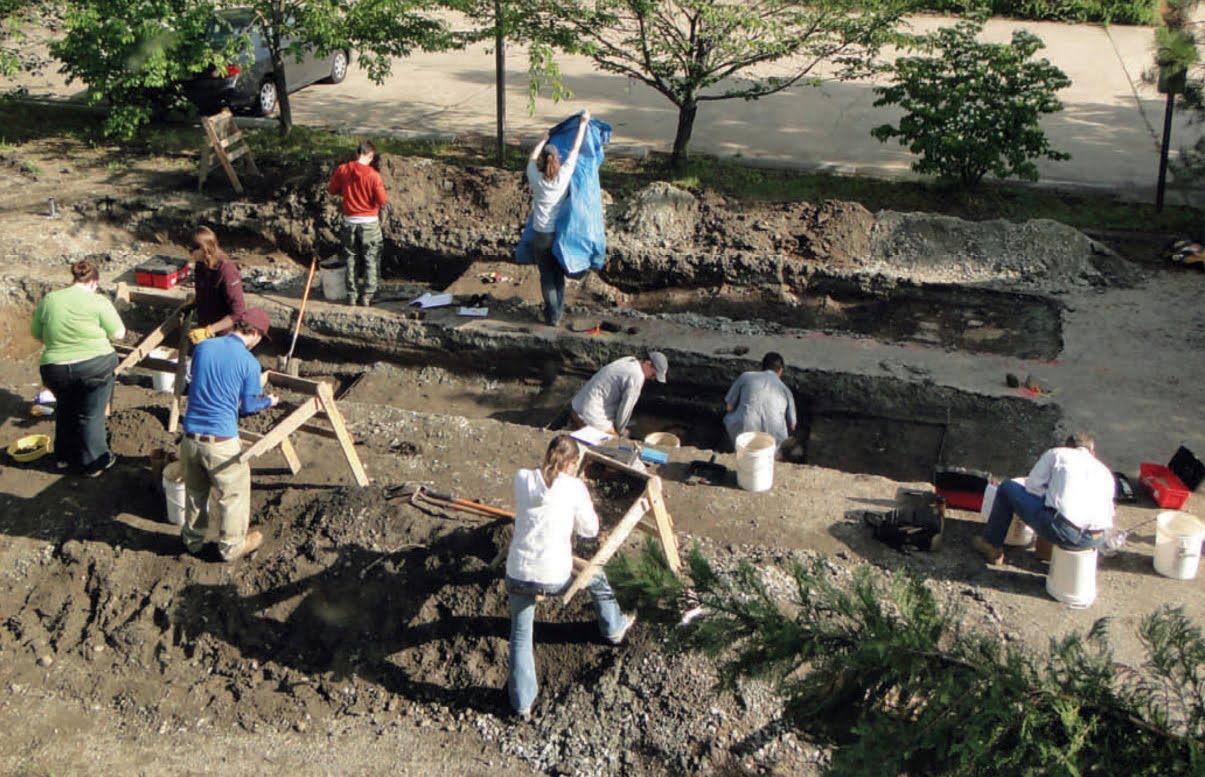
We had an interesting start to our fieldwork today. First of all, it was hot! Real hot! But we all managed to stay cool and hydrated. We are lucky to have tents to block out the sun, and shade the soil so we can see delicate soil stains easier. We had a visit from our Gradall friends from State Highways. They helped us open new trenches and set up silt fencing for our water screening operation.

Frank’s unit, picking up from where we had stopped three weeks ago, picked up the traces of more 19th century postholes, then uncovered the corner of a brick foundation. Numerous 18th century artifacts coming out of this unit suggest we may be into the earlier eras of the property’s history.

Julie and Nichole worked on the stone foundation in the east side of the site. Right now it is showing signs of the remnants of a fire in later levels, dating to the early twentieth century. We still do not know the age of the stone foundation or it’s function. Maybe the next week will shed some light.

In the western-most unit, we cleared part of the trench off to reveal an exciting architectural arrangement. It appears to be a well, possibly dating to the 19th century. It is made of mortared bricks. Unfortunately, it looks to have been filled in with paving debris sometime after the 1960’s. Removing some of it, I quickly came upon the water table. Besides the well, several other curious soils stains look interesting in this unit.

Our work went smoother today with the help of Jeremy, who volunteered to help us out with artifacts on this hot day. Thanks! Tomorrow looks to be another very warm, and exciting, day.