Thursday, September 16, 2010

Market Master's House, Season Two, Day Four, A Day of Transitions

Quiet around here after the excitement of yesterday. A brief post from Molly Russell today:

Hi from the Market Master’s House! It has been a fairly slow day here – well, at least it has for one unit. Unit 9, the one I have been gracing with my presence, has featured a whole lot of digging and not much artifact-ing. We’ll be finishing it up today and opening up a new unit next to it, so hopefully tomorrow will be a more interesting day. Units 10 and 12, however, have been finding a ton of prehistoric flakes. Mike and Janet pulled a really nice point out of unit 10 this morning, while Jen and Frank have had bag after bag of flakes come out of their unit. It has been said that this is becoming more of a prehistoric site rather than a historic one, and I am starting to agree!

After closing out their unit (10) just before lunch, Mike and Janet opened up a new one (14). So far they have found a mixture of artifacts from different centuries, which makes us wonder how intact the historic material will be in that unit. That question will most likely have to wait until tomorrow. So, I guess you could say this site is a ‘to be continued…’

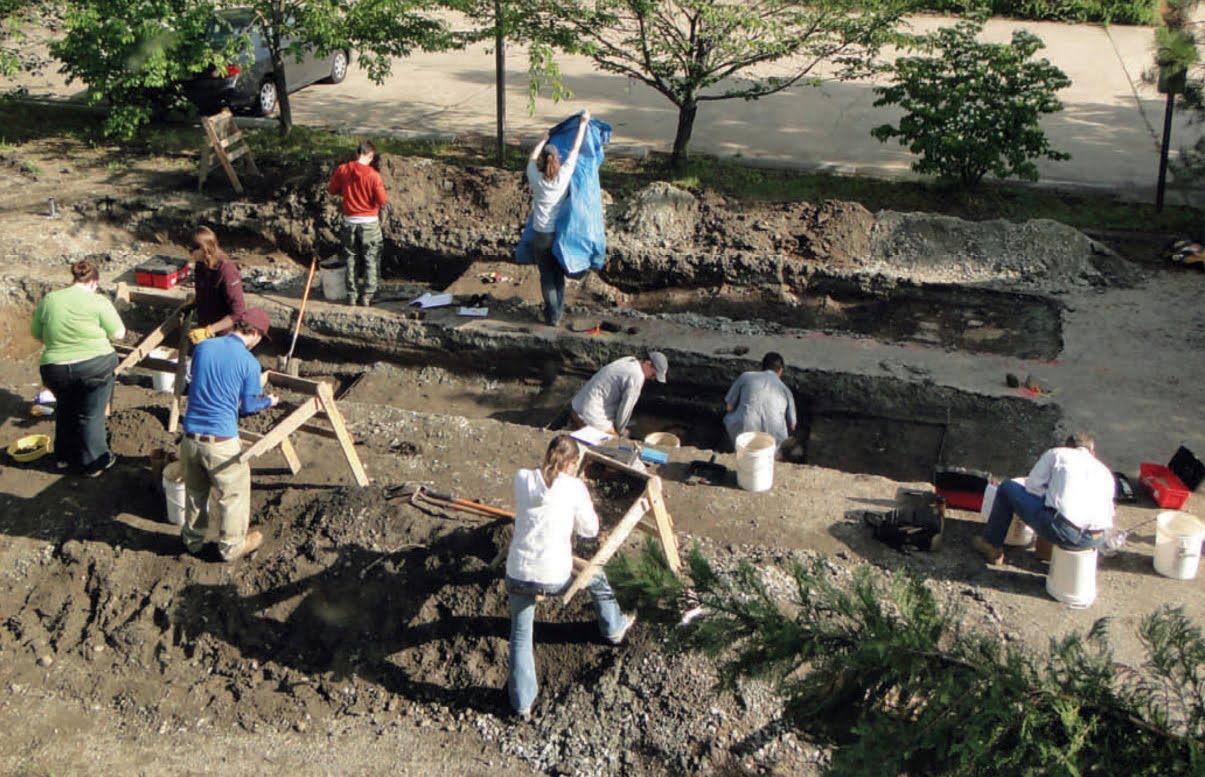
Top photo, by Janet Donlin, of a caterpillar on a screen. Below, Top: Courtney Singleton digging out the bottom of Unit 9. Middle: Nichole Sorenson-Mutchie profiling the wall of the same unit. Bottom: View of the site from the east.


Wednesday, September 15, 2010

Market Master's House, Second Season, Day 3, What a Surprise Today!

Everyone came in feeling a bit tired for our third day of fieldwork. We have had an interesting few days, but are already coming towards the bottoms of our first units. Luckily, we found some pretty neat stuff! Another piece of the puzzle we are putting together about Bladensburg's history. We asked Frank Mikolic and Zak Andrews to talk about what they were finding in Test Unit 12, located in the central portion of the site. Here is what Zak had to say:

"When I arrived at the Market House in Bladensburg this morning, I thought I knew what to expect; glass shards, maybe some nineteenth century ceramic, bits of bone. To my surprise, not even an hour into one of the central units here, we came upon a discovery of a prehistoric stone point found at its’ northeast corner. 30 minutes later, a second stone point poked its head out of the past into our hands. The two points were accompanied by a few dozen stone flakes, none much larger than the size of my pinky fingernail. Prehistoric/archaic artifacts were the last thing I was expecting to find among the colonial theme of things, so naturally I am thinking, “What does this all mean!?” With the help of my Maryland colleagues and the fine staff at the SHA, I’m sure we can come to the bottom of this mystery. This was my first discovery of a worked stone since my emerging practice into the field of historic archaeology and has surely caught my interest. Just goes to show you that you can never be too sure of what you might find out in the field; the past might just surprise you."

And Frank:

"Test Unit 12 produced excitement from the beginning of the morning until late into the afternoon. We kicked off the unit excavation by finding a 1865 2-cent coin along with various late eighteenth century ceramic types, including English Brown, Scratch Blue, Jackfield, and White Salt Glaze. Although there seemed to be some intrusions of nineteenth century artifacts, including the 1865 coin, the majority of artifacts recovered today within TU 12 dated to the late eighteenth century. Below this layer we began to recover a large amount of rhyolite flakes along with two rhyolite broadspear-type projectile points. Finding so much rhyolite in Prince George’s County is significant as much of the prehistoric lithics recovered in PG County and neighboring Montgomery County are from quartz and quartzite materials. Two fragments of prehistoric ceramic were also recovered during excavation of TU 12; it seems to be grit-tempered, but further analysis will be need to confirm both the temper and type. Our excavation of the test unit is approaching the sub-soil and we will likely complete it tomorrow morning. I am looking forward to the excavation of the adjacent unit so we can chase this rhyolite artifact concentration."

Tuesday, September 14, 2010

Market Master's House, Season Two, Day Two

This message was written by Rick Ervin from the Maryland State Highway Administration:

It’s been a hectic week. I just returned to the area following a week in Detroit, and started fieldwork at the Market Masters House the following day. My excursion to Dearborn, Michigan involved a reunion of WWII veterans who flew B-26 Marauders during the war (my interest stems from the fact that my late father was also a veteran). (see this website for more information: http://www.b-26mhs.org/) I was pleasantly surprised to find out that Courtney, one of the crew, had a grandfather who flew in the B-26. A small world!

We started a test unit at the back of the Market Masters property on Monday. So far, we’ve had a mix of everything between about 1800 and late 2008. Late this morning we started excavating a feature – the boundary appeared somewhat amorphous, but it was obviously different from the surrounding matrix. As it turned out, we had a trench for a water pipe. Although I had hoped it might have turned out to be a little earlier, we are starting to find some earlier ceramics, including edgeware and various transfer print sherds.

We also found a small cross, about which Courtney may have more to say in the near future. We’ve heard that the cinder block garage situated within 20 feet of our unit was once part of a small service station or auto repair shop. We’ve found a few artifacts that appear to be tool parts and may relate to the garage.

Earlier today, another unit produced a lead musket ball that probably relates to the Battle of Bladensburg. A quick measurement indicates that the diameter of the ball is slightly more than one-half inch, suggesting that it may represent an American round that was fired into the British positions within the town of Bladensburg. Most of the American militia units were armed with .58 caliber muskets that fired a ball with a slightly small diameter (about .52 caliber). See a picture of the musket ball below, along with a thimble found in the same stratum, possibly dating to around the same time:
Earlier, the family that lives here stopped by to see the site. Unfortunately, we had not found much at the time they stopped by. Hopefully they will come back soon so we can show them the good stuff – we appreciate their hospitality!

The weather of course has been perfect now that the heat of summer is dissipating. Despite the traffic noise, we have quite an idyllic setting here under the trees. However, we just heard the call to start packing up for the day, so its time to sign off for now.....

Monday, September 13, 2010

Today, archaeologists from the Maryland State Highway Administration and University of Maryland students returned to the Market Master’s House. Over the next two weeks we will be excavating south of the house and in the backyard in an attempt to find the remains of out buildings and refuse deposits. Our work is especially important this year since we are trying to understand how the area behind the house was used by the occupants. Last year we encountered post molds that suggested buildings may lie behind us to the south. Old maps and historic descriptions revealed nothing about how this area was developed and that is why archaeology is so important.

After excavating almost 20 shovel test pits, we opened up three five foot by five foot units and just made it through the first stratum. After finding a plastic dinosaur, we soon came down upon 19th and some colonial artifacts. There is nothing too out of the ordinary yet, but we hope to connect the post molds from last year to see if we can recognize a structure.
Research Update

After our excavation last year, we hit the old records to learn what the Market Master’s house was really used for and who lived here. What we learned is that there is no documentation for the building being lived in by a “market master”. Instead, the building appears to have been Christopher Lowndes’ store and one of the first mail stops in the country. It is possible people lived above the store, but based on the probate inventory the store was packed with a long list of items that would have made for camped quarters. By the late 1850s, Dr. Anderson bought the lot with Lowndes’ old store and he lived with his wife in a separate residence to the southeast on the same lot. We are not sure if the old store was used as a doctor’s office or rented out. The 1860 slave census does show Thomas Anderson owning a 51 year old female and 12 year old male slave. Did they use the Market Master’s House as a slave quarter? We may never know for sure, but is something to keep in mind as we examine the mid 19th century artifact assemblage.

Thursday, August 5, 2010

Searching for the USS Scorpion

The following post was written by SHA lab director, Nichole Sorensen-Mutchie.

The Bladensburg Archaeology Project has now branched out into the waters of the Patuxant River in Upper Marlboro. The Maryland State Highway Administration (SHA) in partnership with the US Navy and Maryland Historical Trust has begun the search for Commodore Joshua Barney's flagship, the USS Scorpion. With the British in pursuit, Barney (pictured below) ordered the burning of his flotilla. It was better to have the ships destroyed than have them fall into enemy hands. After the ships were scuttled, Barney and his men went to Bladensburg on foot and fought in the battle there.

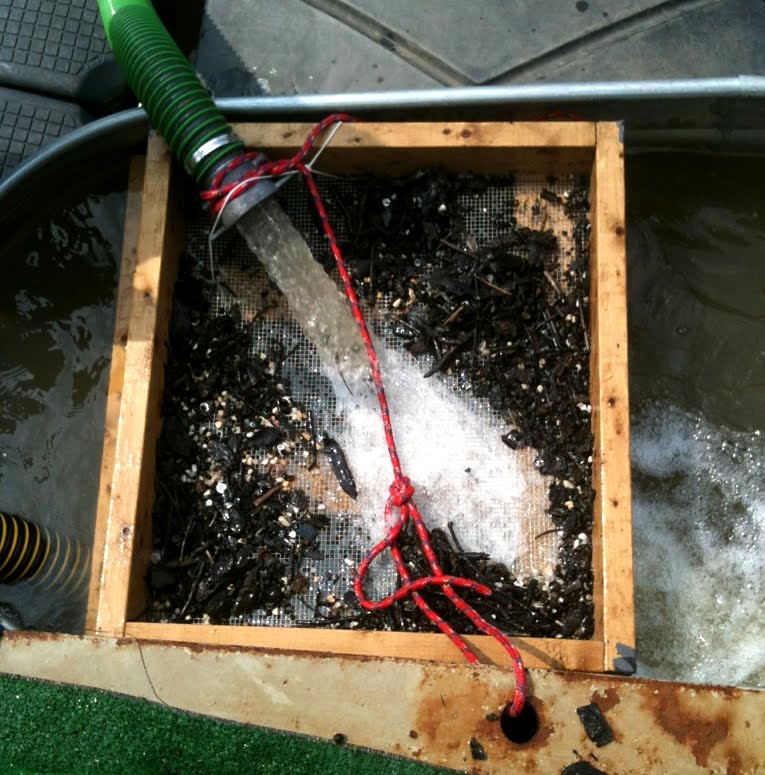
I spent the last two days assisting in the underwater archaeology operations underway to confirm the location of the USS Scorpion. This was a new experience for me, I had never worked on a shipwreck site. I couldn't help but think about how both terrestrial and underwater archaeologist have the same mission, but with completely different methods. First, you are confined to a metal barge! As you can see from the lower right picture, a lot of equipment is needed, which doesn't leave much room to move around. Then there is the various dangers the divers could potentially face. For one diver in the water, there are several people assisting them up top to communicate with them and be ready to jump in should the diver get into trouble. "Digging" is done with dredge, a motorized vacuum system that sucks water, sand and artifacts from the river floor to the surface. The sediment and artifacts then flow into a screen on the surface, which is inside a metal tub as seen in the lower left picture. Another hose is inside the tub to pump out excess water and sand into a holding tank to later be disposed of. No artifacts associated with the shipwreck were found while I was there, however the divers have come down on the wooden planks. Although there is very low visibility in the water, a lot is being learned about where exactly the ship is and how it is oriented.


There is a separate blog for the USS Scorpion project. Please visit http://www.scorpionarchaeology.blogspot.com/, as well as the Facebook page, USS Scorpion Project.

Tuesday, July 20, 2010

The Crab Bulletin, Special Bladensburg Edition


The Cultural Resources Section at the Maryland State Highway Administration (SHA) produces a quarterly newsletter. The summer edition of the Cultural Resources Bulletin (CRaB) is a special extended issue.
It includes in-depth articles on the Bladensburg Archaeology Project, as well as information on other SHA projects. Click on the newsletter link below to read the full edition:

Friday, July 2, 2010

The Volunteer Experience at the Indian Queen: "Why we do what we do..."


This blogpost was written by Olivia Lane, who volunteered her time to help us out in the field this past week. Thanks Olivia!:

Finding the remains of lives long past is a humbling experience, and I would like to thank the State Highway Administration’s Cultural Resources department for allowing me to participate. Sifting through the dirt taught me, contrary to my recent college experiences, that not all PhD’s are afraid of getting dirty. Some actually enjoy their work, and the opportunity to share it with others—mud included. The artifacts uncovered at the site challenge the validity of word-count value of even the best photograph. There is something almost sacred about discovering and holding a tiny piece of a past life in your hands. A shard of pottery with an intricate, hand-painted flower design speaks to the eternal human need for aesthetics and beauty. A child’s marble tells of a simple childhood full of companionship and games. A pig’s jaw bone with teeth intact announces what may have been for dinner.

These artifacts can tell us as much about ourselves as they do about their previous owners. What things will we leave behind, and what will they say about us? Our legacy is everywhere—from plastic water bottles and McDonald’s® wrappers to outdated electronics. But uncovering these items may not hold the same value as the items unearthed at the Indian Queen Tavern, nor will their discovery be as difficult. The trash of the modern world is everywhere, and the half-life of a Dunkin Donuts® Styrofoam coffee cup is much longer than that of a hand-made children’s toy.
Archaeology may be partially about uncovering and preserving the past. It may be partially about learning about the details of the lives that came before us. But to fully understand the field, we must understand that we are finding out about ourselves. As technology and science advance at rapid speed, many things in our lives may change. Our basic needs never do. If we choose to focus on the similarities uncovered in Bladensburg, we may still have a fighting chance.